How an AI receptionist actually works.
An AI receptionist is not a voice floating above a phone line. It is a small operating system, one that has to know when to stop and bring in a person.
A useful implementation has to hear the caller, understand the request, retrieve approved information, decide what it is allowed to do, take an action in another system, confirm the result, and record what happened. It also needs to recognize when it should stop and bring in a person.
That last function is core to the architecture.
The system in eight moves
The system accepts the call, plays the approved greeting, and makes any required disclosure. Audio begins moving through speech recognition so the conversation can be processed in real time.
The caller's request is matched to a defined intent: booking, rescheduling, service-area questions, hours, pricing, or an existing customer issue. When it can't classify a request, the system should escalate rather than improvise. Low confidence is a routing signal.
The receptionist pulls from an approved knowledge source rather than the open internet or an unconstrained prompt: services, hours, locations, policies, pricing boundaries, availability rules. Good retrieval is narrow. The system should know exactly where its authority ends.
Before responding or acting, the system checks the request against operating rules. Can it quote this price? Book this service? Is the caller inside the service area? Does this call require a licensed person, manager, or human judgment? This is where a demo becomes an operating system.
Approved tasks move into connected systems: check a calendar, create or update a CRM record, send an SMS confirmation, assign an owner, place a follow-up task in a queue. The call is valuable when it resolves work; sounding natural isn't the bar.
The system repeats the important outcome back to the caller: appointment time, address, next step, expected callback window. Confirmation reduces silent errors and gives the caller a chance to correct the record.
Some calls should move to a person immediately: distress, safety concerns, complaints, pricing exceptions, sensitive information, low confidence, repeated misunderstanding, or a direct request for a human. The handoff needs an owner, a destination, and a fallback. “Transfer failed” is not a process.
The system records the transcript, intent, actions, handoff status, and final outcome. A person reviews a sample of calls, especially failed and non-escalated ones, then updates the knowledge and policy layers. Improvement comes from that governed review, never from the system drifting on its own.
The artifact
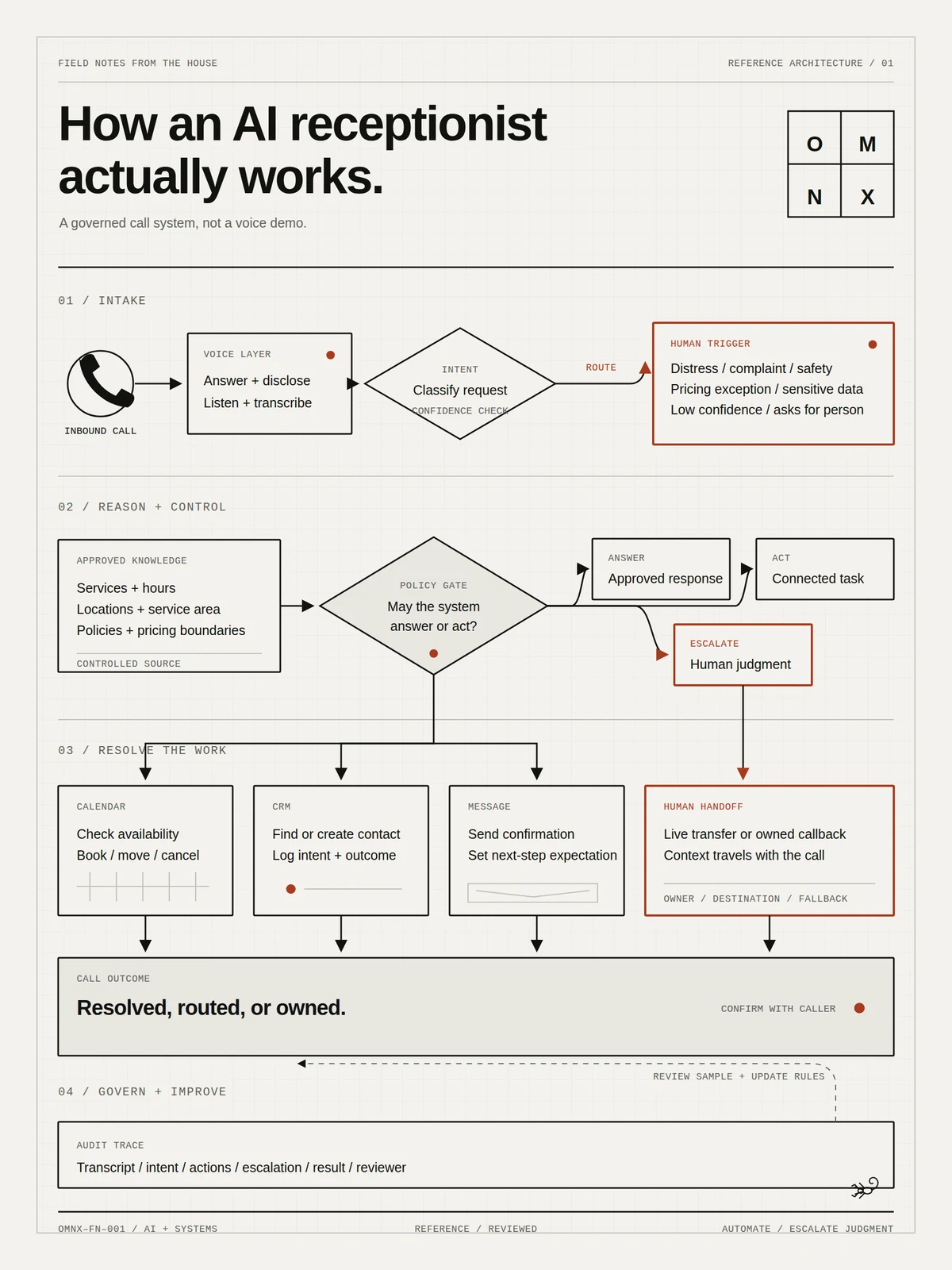
Automate the repeatable request. Escalate the consequential judgment.
The right architecture is not AI instead of humans. It is a deliberate division of labor between fast, consistent automation and accountable human judgment.
What Omnox would inspect first
- The last 30 days of call types and missed calls.
- The tasks callers expect to complete during the call.
- The systems required to complete those tasks.
- The information the receptionist may and may not provide.
- The events that require immediate human ownership.
- The fallback when a transfer or integration fails.
- The review process after launch.
Field decision
Do not begin with a vendor demo. Begin with the call map.
The blueprint above is a reference architecture. A production implementation should be adapted to the company's call patterns, systems, risk, and operating policies.
Request a call-flow review